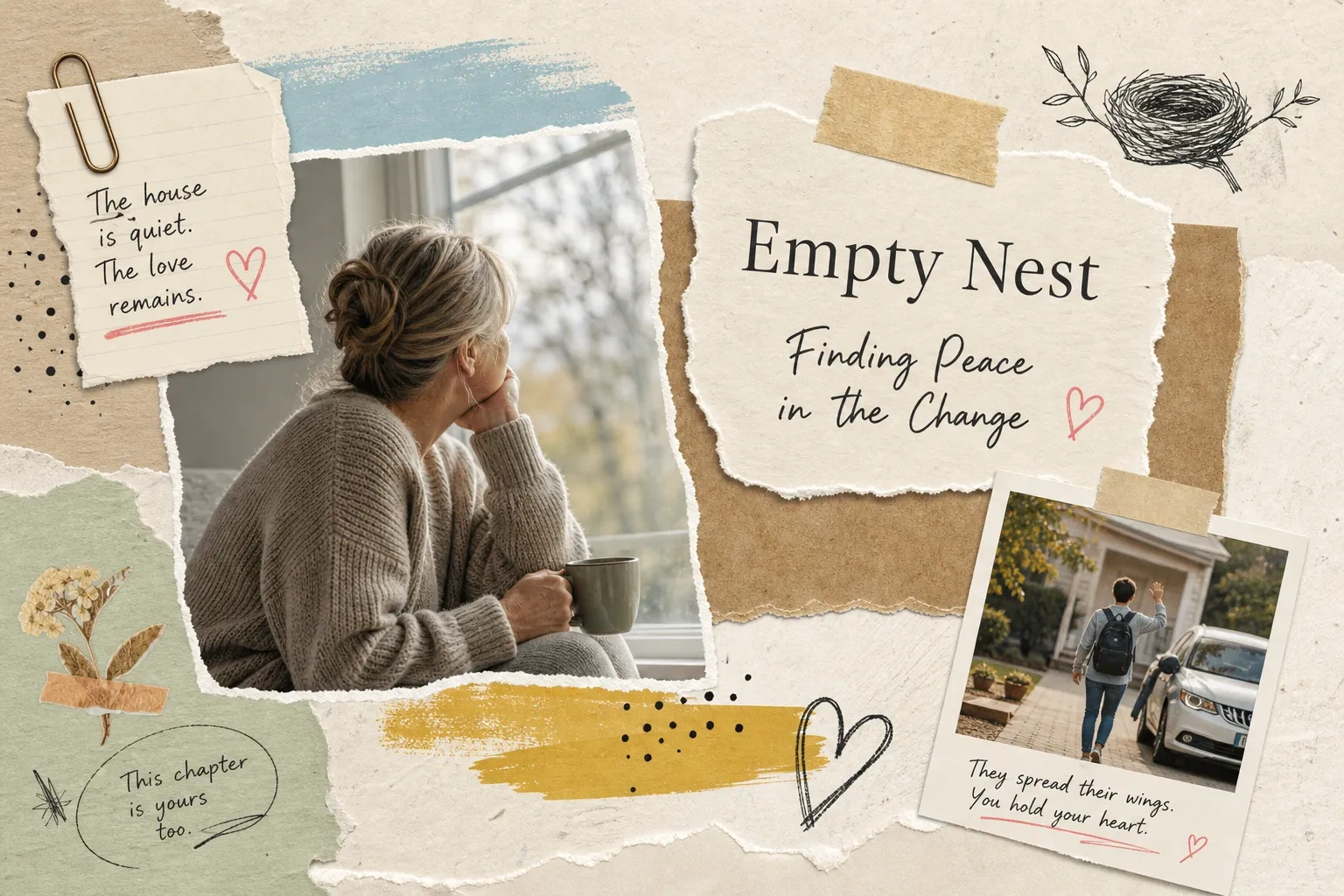
The Tuesday after drop-off, the house is completely quiet. The cereal bowl you set out from habit sits untouched on the counter. You walk past a bedroom door and feel something you weren't fully prepared for: a hollow, disorienting grief that doesn't quite have a name. Empty nest syndrome is that grief, and it is more common, more documented, and more real than most women are told before they live it.
Studies estimate that somewhere between 10% and 27% of parents report experiencing empty nest syndrome, depending on the population surveyed and how the condition is defined. One frequently cited study put the figure at roughly 27%, though U.S.-based research tends to find rates closer to the lower end of that range. Some studies find mothers affected at higher rates than fathers, one reported 31.6% versus 22.5%, though other U.S. findings show only a modest difference or no statistically significant gap. What is consistent across the literature is that the gap, when it appears, reflects something structural about how many women build their lives around caregiving and what happens when that organizing center shifts. This article gives you a clear picture of what this transition actually looks like, why it lands so hard, and a practical path through it, including the kind of community support that meets you where you actually are right now.
Why empty nest syndrome hits mothers harder than expected
The identity math no one prepares you for
For many women, especially those who centered their daily lives around caregiving, a child leaving home doesn't just change the schedule. It removes a primary source of identity, relational rhythm, and daily meaning all at once. Sociologists call this "role exit": when a role you've inhabited for most of your adult life disappears almost overnight, the self doesn't automatically fill in the gaps. You are still you, but the daily structure that organized your sense of purpose is gone.
The cultural narrative makes this harder, not easier. Society tends to romanticize the empty nest as freedom, as a reward for parenting well, a view that research on the social messaging around motherhood suggests is pervasive but poorly aligned with many women's actual experience. That framing leaves women feeling ashamed of their grief rather than supported through it. When you're told you should be celebrating and you're instead crying in a grocery store, the isolation compounds the loss.
Who feels empty nest syndrome most acutely
Mothers report higher rates of empty-nest distress than fathers across several studies, though the size of the gap varies and not all research finds it statistically significant. Stay-at-home parents and primary caregivers experience the largest disruption in daily purpose and routine. Single parents face a particular version of this: they often lose not just a caregiver role but their primary source of daily companionship. Women who are simultaneously navigating midlife transitions, career questioning, relationship changes, or aging parents, feel the weight of multiple endings at once.
Cross-cultural data reveals just how much social expectations shape empty nest syndrome. In one cross-cultural study, reported rates varied considerably by country: Indo/East Indian participants reported rates around 58%, compared with roughly 20% or below among British, Southern European, and Chinese participants. That range suggests how directly a culture's tie between a woman's identity and motherhood influences how much loss she experiences when that chapter closes. Results across countries reflect different sampling methods and contexts, so direct comparisons require some caution.
What empty nest syndrome actually feels like, and when it becomes something more
The normal spectrum of post-parenting adjustment
The emotional landscape of this transition is wider than most people expect. Persistent sadness, unexpected loneliness, irritability, difficulty concentrating, a hollow sense that something essential is missing, these are all common. So is the strange guilt of feeling grief when you know your child is thriving. "I should be happy for them" and genuine loss can coexist. Both are true at the same time, and that paradox is one of the most disorienting parts of this season.
Normal empty-nest adjustment fluctuates. It allows for moments of real joy and gradually eases as new routines emerge. The key distinction is that normal adjustment trends toward adaptation over weeks and months; it doesn't lock in and worsen. Most women feel substantially better within two to six months, though full adjustment takes longer for some. Life after kids leave is rarely the clean "freedom chapter" the cultural script promises, it's a genuine transition that deserves real support.
Signs the adjustment has become something you shouldn't carry alone
When distress intensifies rather than eases, it's worth paying closer attention. The following signs suggest the transition has moved into territory that benefits from professional support:
Depressed mood most of the day, nearly every day, for two weeks or more
Loss of pleasure in activities that used to bring enjoyment, not just parenting-related ones
Significant changes in sleep, appetite, energy, or concentration
Persistent feelings of worthlessness or hopelessness that don't ease with time
Difficulty functioning at work, in relationships, or inbasic daily self-care
Empty-nest depression isn't a formal clinical diagnosis on its own, but it can evolve into major depressive disorder or an adjustment disorder that requires real treatment. Duration, severity, and functional impact are the markers to watch. If symptoms intensify after several weeks rather than settling, a conversation with your doctor or therapist is the right next step, not a sign of failure.
A 90-day framework for rebuilding your daily life
Days 1, 30: Anchor before you accelerate
The first priority is stabilizing the basics. Consistent sleep and wake times, regular meals, and daily movement create a foundation that grief can't easily dismantle. Think of this month as structural: you're not trying to reinvent yourself yet. You're keeping the house from falling down while you figure out the blueprints. One concrete social contact per day, a text, a call, an invitation, keeps isolation from solidifying into habit.
Establish a few "anchor connections" each week: one friend, a community activity, a family check-in with your adult child. Create a communication rhythm with your child that gives both of you predictability without placing your emotional needs on their shoulders. And restore one interest that existed before intensive parenting. Not a new identity project, just a return to something that was already yours.
Days 31, 60: Deepen one thing at a time
This month is about converting experiments into commitments. Make one social activity recurring rather than ad hoc: the same walking group, the same Tuesday evening class. Recurring commitments build belonging faster than occasional heroic effort. Volunteer two or three times in a cause that aligns with your values; contribution creates both purpose and relationships simultaneously, which is a rare combination.
Try two new activities, one social, one skill-based, and keep only what genuinely energizes you afterward. If you're partnered, schedule a weekly shared activity that has nothing to do with your children. If you're single, schedule time with someone you want to know more deeply. Shared activity creates belonging faster than conversation alone, and this month is about building the structure that makes belonging possible.
Days 61, 90: Build something that belongs to you
Choose one community to join consistently rather than continuing to sample. Start a modest purpose project, mentoring, community organizing, creative work, or learning something new with a concrete 90-day goal. Purpose doesn't require a grand reinvention; it requires a direction, something that earns your attention and gives the week a shape beyond routine.
Put one future highlight on the calendar, a trip or a course you've been meaning to take, so you have something to look forward to beyond obligation. Review which relationships feel reciprocal and invest more there. Small, repeated contact beats occasional heroic plans. The women who rebuild most fully in this season aren't the ones who feel less; they're the ones who keep showing up for small, consistent connection. For empty nesters especially, that consistency is what transforms acquaintances into genuine community.
Rebuilding the relationship that's been quietly waiting
How the couple dynamic shifts when the house empties
For partnered women, the empty nest often surfaces something that's been developing quietly for years: the children were the default common ground. Without that organizing principle, some couples feel like strangers who shared logistics. This isn't failure. It's the relationship asking for direct attention, possibly for the first time in a long time.
Coping with kids leaving often means rediscovering what you and your partner actually want from daily life, from each other, from this next chapter. That's a real conversation, and it takes some courage to start. Several longitudinal studies suggest that marital satisfaction often rises modestly after the last child leaves, particularly when couples name what has shifted and address it directly rather than waiting for it to resolve on its own.
Conversation structures that open the door
The feeling-need-request framework is a widely recommended structure for these conversations, drawn from research on couples communication during transitions: "When [specific situation] happens, I feel [emotion] because I need [need]. Would you be willing to try [clear, realistic request]?" It keeps the conversation grounded in observable experience rather than character judgments. A practical version: "When we go several days without checking in, I feel disconnected. I need reassurance that we're still a team. Could we have a 15-minute phone-free check-in twice a week?"
The most clarifying question couples can ask each other right now is simple: "What do you miss, what do you need more of, and what are you willing to try?" If the same conversation loops without resolution, or if the transition surfaces deeper disconnects, couples therapy is worth pursuing. It's not a last resort; it's the right tool for a significant transition that two people are navigating at the same time.
Finding your people in this season of life
Why peer connection is not optional during this transition
The research on adjustment after major life transitions is consistent: social connection isn't just helpful, it's structural. The trap many women fall into after children leave is waiting to feel better before seeking community. The sequence actually runs the other way, you find the people first, and the feeling follows. What matters most is finding women who are living the same chapter, not just sympathetic listeners who offer care but can't fully relate because they're in a different season entirely. That shared context is what makes peer connection qualitatively different from ordinary support.
Where lifecycle-matched community makes the difference
Generic social apps and broad support groups often can't offer what this transition specifically requires: peers who are in the same season, processing the same disorientation, without the performance pressure of follower counts or curated highlight reels. That specificity matters more than most people realize when they're in the middle of empty nest syndrome grief.
Seasons Women is a private, app-based community designed for exactly this kind of lifecycle-matched connection. It uses a lifecycle-based onboarding process to place women in circles built around their current life stage, including a dedicated circle for women navigating the empty nest season. Inside these circles, empty nesters connect with others living the same quiet readjustment: rediscovering purpose after parenting, renegotiating identity, and rebuilding daily life without comparison culture or public feeds. No follower counts. No performative posts. Just honest conversation with women who genuinely understand what this season asks of you. Seasons Women is available on the App Store, and the onboarding is designed to get you to the right circle without a lot of searching.
When empty nest syndrome needs professional help
Signs it's time to talk to a professional
If your symptoms intensify rather than ease after several weeks, professional support is appropriate. The markers to watch are persistent low mood, loss of interest in activities you used to enjoy, sleep or appetite changes that aren't resolving, difficulty functioning at work or in relationships, and feelings of emptiness or hopelessness that don't shift with time. Empty-nest depression can meet the clinical criteria for major depressive disorder; the fact that it was triggered by a life transition doesn't make it less real or less treatable.
What the evidence says actually helps
Cognitive behavioral therapy (CBT) has the strongest evidence base for adjustment-related depression among the approaches commonly recommended for this transition. It directly targets thought patterns ("I have no purpose now") and behavioral withdrawal that sustain distress, while building new routines, roles, and sources of meaning. It's worth noting that research specifically on empty nest syndrome treatments is still limited; most of the CBT evidence base comes from studies on adjustment disorder and depression more broadly. Mindfulness practices are a useful complement, particularly for tolerating identity shift without excessive rumination, though they work better as an adjunct than a stand-alone treatment for significant distress.
A practical stepped-care approach: start with behavioral activation and peer support for mild distress. Move to individual CBT for persistent symptoms. Seek clinical assessment for anything lasting several months, accompanied by significant functional impairment, or involving thoughts of self-harm. The threshold for getting support should be lower than most women set it for themselves.
This season has something real inside it
The empty nest is not an ending, even when it feels exactly like one. It's an unmapped season, one that asks something genuine of you and holds real possibility on the other side of the adjustment. The core arc is straightforward: name what you're feeling without shame, stabilize the basics, rebuild connection one recurring commitment at a time, and don't isolate when the grief feels heaviest.
Empty nest syndrome is real, it's documented, and it's also navigable. The women who move through it most fully aren't the ones who feel less. They're the ones who find the right people to feel it with, women who are in the same season, asking the same questions, and willing to show up honestly for each other. Life after kids is its own chapter, and it deserves the same intention you brought to every chapter before it.
If you're ready for that kind of community, Seasons Women is built for this chapter specifically. Find it on the App Store and let the onboarding place you where you actually are right now.