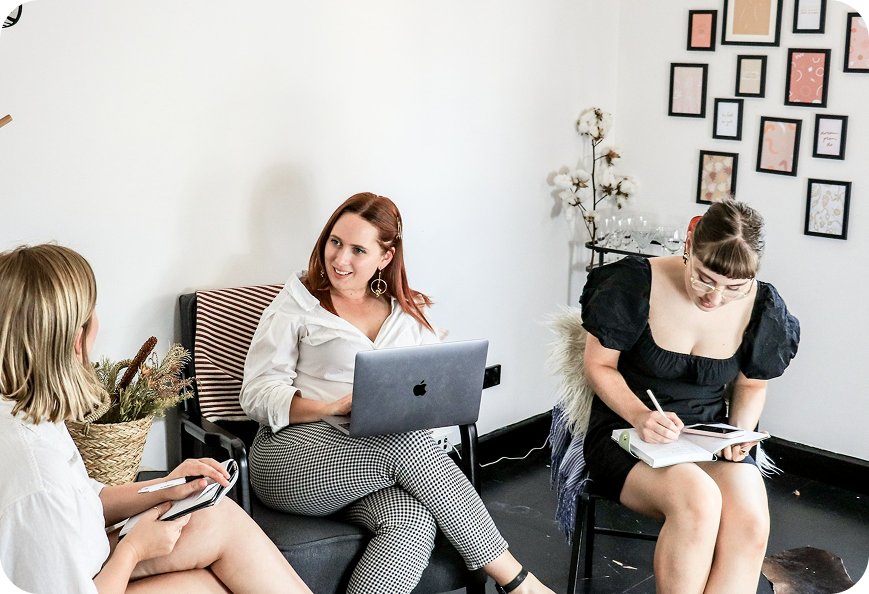
There’s a certain kind of exhale that happens when women walk into the right room.
Not every room.
Not every group.
But that room.
The one where nobody is trying to impress anyone.
Where women stop filtering themselves halfway through a sentence.
Where you can say the true thing instead of the polished thing.
You can almost feel it physically.
Shoulders drop.
Voices soften.
People laugh differently.
Something in the body relaxes before the brain even catches up.
That’s what good women-only spaces do.
And honestly, in the world we’re living in right now, that kind of space doesn’t feel like a luxury anymore.
It feels necessary.
What Women Are Quietly Carrying Every Day
Most women are used to managing themselves constantly in mixed spaces.
So used to it that many barely notice it anymore.
Until suddenly they’re somewhere they don't have to.
Then the difference becomes obvious.
In professional settings, women still get interrupted more. Their ideas get repeated by somebody else and somehow land better the second time. If they’re direct, they’re “too much.” If they’re warm, they’re “not serious enough.”
It’s exhausting.
Not dramatic exhausting.
Quiet exhausting.
The kind that builds slowly over years.
And eventually women adapt to it so completely that it becomes background noise.
Until they enter a space where the noise disappears.
That’s when they realise how much energy they were spending just managing perception all day.
Something Changes When Women Don’t Feel Watched
This part is hard to explain unless you’ve experienced it.
When women feel emotionally safe, conversations change completely.
People stop performing competence every second.
They admit things.
Fear. Burnout. Resentment. Loneliness. Confusion. Big dreams they were embarrassed to say out loud before.
And weirdly enough, once one woman is honest, everyone else starts becoming honest too.
It spreads fast.
Like relief.
The Research Actually Backs This Up
This isn’t just emotional storytelling either. The data supports it pretty consistently.
In education, women in all-female environments are more likely to speak up, lead discussions, and pursue fields like STEM with more confidence.
In leadership programs, women report higher confidence, stronger decision-making, and more willingness to take risks.
In mental health spaces, women in women-only groups often open up faster and trust more deeply.
And in business? Women with strong circles of female support are significantly more likely to advance into leadership roles.
Not because somebody handed them opportunities.
Because support changes what people believe is possible for themselves.
That matters a lot more than people think.
Women-Only Spaces Change Specific Things
Not abstract things.
Real things.
Conversations become deeper
There are conversations women have with each other that often never fully happen in mixed spaces.
About burnout. Fertility. Career guilt. Motherhood. Divorce. Aging. Safety. Pressure. Loneliness. Being underestimated constantly.
Not because men are evil.
Not because women hate men.
Because shared experience creates a certain kind of shorthand.
Women don’t always have to explain the emotional context to each other first.
And honestly? That changes the depth of the conversation immediately.
Women take up more space
A lot of women were taught very early to shrink themselves a little.
Talk softer.
Don’t interrupt.
Don’t be “too ambitious.”
Don’t be intimidating.
Women-only spaces tend to interrupt that conditioning.
You see women speaking longer. Asking bigger questions. Taking leadership naturally instead of apologetically.
Sometimes for the first time in years.
Failure becomes less terrifying
This one matters a lot.
Women are often judged harshly for mistakes. So many become perfectionists without even realising it.
But in the right women-only spaces, failure becomes discussable.
A woman can say: "My business failed.”
Or: "I’m struggling mentally lately.”
And instead of silence or judgment, people lean in closer.
That kind of support changes people quietly.
The Pushback Usually Misses the Point
Women-only spaces always get questioned.
“Aren’t they exclusionary?
“Shouldn’t women just integrate into existing spaces?
“Isn’t this divisive?”
But honestly, every community has boundaries.
Professional associations do. Alumni groups do. Religious communities do.
Creating a space specifically designed around women’s experiences is not some radical idea.
It’s a response to a very real need.
And importantly — women-only spaces are not anti-men.
They’re pro-safety.
Pro-honesty.
Pro-connection.
Big difference.
Why This Feels More Important Right Now
The timing matters.
The last few years changed people a lot.
Remote work increased isolation. Social media increased performance. Everybody became more “connected,” while simultaneously feeling more unknown.
Women especially are carrying enormous emotional load right now.
Career pressure.
Family pressure. Mental exhaustion.
Constant visibility online.
And many of the places women are expected to connect digitally are built around attention instead of care.
That creates emptiness after a while.
You can have followers and still feel invisible.
You can have group chats and still feel alone.
You can have “community” technically… without actually feeling supported.
That’s why women-only spaces feel more urgent now than they did before.
Not because women suddenly changed.
Because the world around them did.
What a Good Women-Only Space Actually Feels Like
Not all women-only spaces are automatically good.
Some still recreate the same performance culture women are already exhausted by.
The best ones feel different.
They:
- value honesty over image
- make room for hard conversations
- encourage depth instead of performance
- support women at every stage, not just the most successful ones
- create actual interaction instead of passive scrolling
Most importantly, women feel emotionally safe enough to be fully themselves there.
Not their professional version.
Not their social media version.
Their actual self.
That’s rare online now.
Really rare.
This Is Why We Built Seasons Women
We built Seasons Women because we kept seeing the same thing over and over again.
Women surrounded by people… but still feeling unsupported.
Women exhausted by social media.
Exhausted by networking culture.
Exhausted by constantly performing strength.
They didn’t need another audience.
They needed somewhere they could exhale.
So Seasons Women was designed differently from the start.
Smaller communities.
Honest conversations.
Shared life stages.
Support that feels human instead of transactional.
A place where women can talk honestly without feeling watched all the time.
Not another app chasing engagement metrics.
A real community.
Or at least that’s what we’re trying to build.